
The best HR software for UK organisations combines UK-specific compliance, an interface people actually use, dependable integrations and room to scale. Ciphr is built for mid-sized UK employers who need those four things from one connected suite.
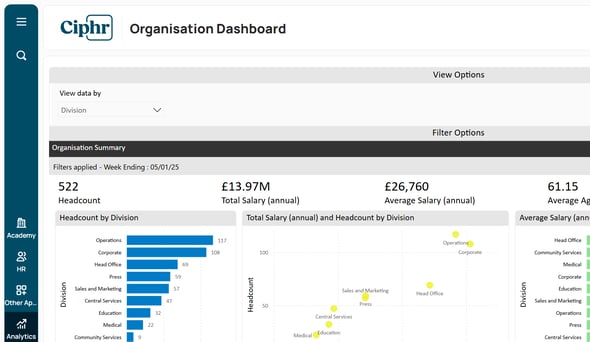
The best HR software comparison for UK organisations
Seven vendors on this comparison page, and all seven will tell you they're the best fit for your organisation. That's not much use to you when you're the one who has to sign the contract and manage what comes after.
The feature list rarely tells you anything useful. Most established HR software has absence management, self-service and a dashboard by now. What separates the good systems from the rest is what happens once HR, payroll, recruitment, learning and benefits need to work together, under UK law, for real employees, every month without fail. Teams that struggle with their HR software usually aren't missing a feature. They're stuck with systems that don't talk to each other. And customer support that doesn’t deliver on its promises.
This page compares Ciphr against other UK HR systems on that basis: UK compliance, implementation support, how connected the data really is, and where AI tools genuinely add value.
Who this HR software comparison is for
This comparison is built for people choosing HR software for a mid-sized UK organisation, not a global enterprise or a five-person start-up. It's most useful if you're:
- An HR director or head of people replacing an outdated or disconnected system
- Running a team of 200 to 2,000 employees, where scale and ease of adoption both matter
- Looking for UK-specific functionality, such as right-to-work checks, UK holiday pay calculations, GDPR and Data Protection Act compliance
- Deciding between an all-in-one suite and a set of best-of-breed point solutions
- A payroll manager or CFO who needs to see the business case, not just the product demo
- Looking for a long-term partner, not a vendor you'll be comparing again in eighteen months
Best HR software in the UK: what separates the top systems
Most HR software comparison pages compare feature lists. That's the easy part. Every serious vendor has absence management, self-service and a reporting dashboard. What separates the best HR systems in the UK is what happens once those features have to work together, under UK law, for real people.
Built for UK compliance, not adapted for it
A lot of HR software sold into the UK market was built for a different market first. That shows up later: in workarounds for GDPR and Data Protection Act requirements, in right-to-work checks that need a workaround, in support that runs on a different time zone to your payroll deadline.
Ciphr is a UK company, headquartered in the UK, supporting UK organisations under UK data protection law. That's not a marketing line: it's where the servers, the support team and the compliance logic all sit.
Implementation you're guided through, not handed over
The point where most HR software promises fall apart isn't the demo. It's the six months after the contract is signed, when someone has to keep data synced across multiple systems, train the team and keep payroll running at the same time.
"It was the smoothest transition I've ever experienced. It lifts a huge weight off you – you can trust them to get on with it."
Structured implementation support is a benefit worth comparing directly, not an afterthought you find out about once you've already signed.
AI that's only as good as the data behind it
Every HR software company on this comparison claims to have AI functionality now. But the real question is whether that AI can see your whole picture, or just the slice of data that happens to sit in that one system.
Ciphr's AI assistant works from your live HR data because HR, payroll, recruitment, learning and benefits sit in one connected suite. Live now: an AI assistant for everyday HR queries, AI form summarisation, and AI coaching through MyTeamBuilder. Ciphr's product roadmap moves toward more autonomous, agentic AI in 2026. That's a near-term step, not a distant promise.
Ciphr vs other HR systems for mid-size companies
| Ciphr | IRIS | MHR | Hibob | Cezanne | |
|---|---|---|---|---|---|
| User rating (Capterra) | 4.2/5 | 3.0/5 | 4.3/5 | 4.6/5 | 4.4/5 |
| AI functionality | Yes | Yes | Yes | Yes | Yes |
| Integrations | Integrated HR and payroll* Integrated HR and LMS Integrated HR and recruitment Pensions via payroll Mature API framework |
DocuSign, PowerBI, Zest, StaffCircle and other third-party apps | Software integration services available | Payroll Sourcing and recruiting ERP and productivity Collaboration Data integrations |
Partners SSO Payroll Microsoft/Google |
| Country HQ | UK | UK/US | UK | US/UK | UK |
* Ciphr-to-Ciphr
This is an HR software comparison you can hold a vendor to, not a features grid designed to flatter one of them. Ask each provider for evidence against every row, including the ones where a competitor scores higher.
Best HR systems UK: three questions worth asking before you choose
Is it user-friendly?
Your people need a system that works without a manual. Prioritise clear design and fast access, so there's less friction for HR and less daily hassle for everyone else.
Does it fit with what you already run?
Check whether it connects to your other business-critical software, not just your HR data. Fewer disjointed systems means fewer discrepancies to chase later.
Does it solve more than one problem?
The strongest HR systems serve employees, managers and the leadership team from the same source of data, with reporting that holds up in the boardroom as well as the inbox.

Built for the reality of UK HR and payroll
Generic global software adapts to UK requirements. Ciphr was built around them: UK employment law, UK payroll legislation, and the audit trail a UK compliance team needs to produce, not one that has to be reconstructed for them.
That shows up in accreditation, not just copy: Ciphr holds BSI ISO 27001 certification for information security, ISO 9001 for quality management, and is a Crown Commercial Service and Microsoft partner.

Proof in the work: what a good HR system comparison should show you
Reports that answer the question before the meeting is even on the calendar. A leaver that triggers the next step automatically, instead of an email chain. Payroll that runs without a re-keying exercise the week before payday.
That's the standard a connected suite should be held to, and it's the standard worth comparing every vendor on this page against: not what the demo shows, but what the work looks like six months in.

Scenario-based recommendations for finding the best UK HR software
“We need stronger UK compliance and audit readiness”
Choose a provider with UK-specific workflows, right to work checks, GDPR controls and transparent audit trails. These features help ensure your processes align with UK legislation and reduce manual compliance effort
“Engagement with our HR system is low”
Prioritise platforms with a modern, user-friendly interface, clear navigation, mobile access and self-service features. High adoption leads to better data accuracy and fewer process bottlenecks
“We’re struggling with system fragmentation - HR, payroll, learning and recruitment don’t talk to each other”
Look for vendors that offer one connected suite, with HR, payroll, recruitment and learning sharing the same underlying data. This reduces duplicate data, minimises errors, and enables smoother end-to-end workflows
“We want better reporting and visibility for senior leadership”
Choose systems with real-time reporting, intuitive dashboards and data that stays consistent across HR and payroll. Strong reporting helps HR demonstrate impact and enables executive teams to make informed decisions
“Our organisation is growing - we don’t want to outgrow our HR system in two years”
Select vendors that scale with your workforce, offer modular products, have a clear product roadmap and support changing organisational needs without requiring a new system. Future-ready platforms minimise disruption by expanding as your needs change
“We can't afford disruption during implementation”
Look for vendors with a structured implementation process, dedicated specialists and ongoing support after go-live. A well-managed implementation helps minimise disruption, supports user adoption and keeps day-to-day operations running throughout the transition
FAQs: Best HR software companies
Mid-sized companies, typically 200 to 2,000 employees, tend to do best with a system that pairs ease of use with UK compliance, solid analytics and integration across HR, payroll and learning, rather than a point solution that solves one problem well and leaves the rest to chance.
Look for a mature API framework and pre-built payroll connections. Ciphr offers integrated HR and payroll as a single connected system, as well as integrations with third-party payroll providers.
User experience, the depth of built-in reporting, UK compliance capability, scalability and integrations. These are the areas that determine day-to-day efficiency and the system's value over the following years, not just at launch.
Cost varies by vendor, modules and support level. Many UK vendors price per employee per month. When you compare cost, include implementation and ongoing support in the total, not just the licence fee.
It's the right fit if it matches your size, your compliance requirements and how complex your processes are, and if it gives you the configurability and reporting you need for HR, employees and leadership alike. Fit also means culture and budget, not just feature coverage.
That depends on your current data and where it lives. A good vendor should have a dedicated implementation team to guide you through data migration, cleaning and training, so switching is a supported project rather than something your team works out alone.
Self-service HR lets employees and HR users manage and update their own information: booking holiday, submitting sick leave, and updating personal details, without it becoming an admin task for someone else.
Most vendors train HR administrators as part of the implementation project, with further training available as the team grows into the system. Employees typically need little to no training if the system is genuinely easy to use.
Ask what the first 90 days look like: who leads the project on the vendor's side, how data migration is handled, and what support looks like once you're live, not just during the sales process.
Get your free guide now
Thinking of new HR software?
Download our ultimate guide to choosing HR software
Find out everything you need to know about choosing the right HR software in our comprehensive guide
Related content
In-house or outsourced payroll? Download our guide to find the best payroll service
Every organisation wants to make sure that its people are being paid accurately and on time. To make the payroll process run as seamlessly as possible, organisations may choose to either run payroll processes in-house, or outsource instead.

Webinar: choosing the right HR software for your growing organisation
If you’re looking to choose your first system or upgrade to more sophisticated software as your organisation grows, tune into this helpful webinar from HR software provider Ciphr in association with recruitment experts hireful.

Need help choosing the right LMS? Download our guide
Choosing the right learning management software (LMS) for your organisation can be a difficult task. Guide yourself through this decision-making process with our guide.