

As organisations look ahead to an increasingly complex and fast-moving future, understanding the L&D trends for 2026 will be critical for HR and learning leaders who want to support their people effectively.
From rising business costs and ongoing skills shortages to the growing influence of AI and shifting employee expectations, the year ahead presents both significant challenges and genuine opportunities for learning and development teams. In this blog post, we explore key L&D trends 2026, the investment priorities shaping the year ahead, and the practical actions L&D teams can take to deliver meaningful, long-term impact.
L&D trends 2026: the big picture impacting HR
In October 2025, we conducted a survey to understand what the 2026 L&D landscape might look like. Nearly 100 L&D and HR professionals from across the UK shared their perspectives, giving us a valuable snapshot of the trends, pressures and priorities shaping the year ahead.
Which trends will most impact L&D teams in 2026?
Our respondents highlighted several forces that are likely to shape L&D decision-making in the coming year:
- Rising cost of business – 76% of respondents expect this to have a moderate or significant effect
- Evolving expectations for learning and career growth – 71.8%
- Artificial intelligence (AI) and emerging technologies – 69.6%
- Skills shortages and reskilling needs – 67.4%
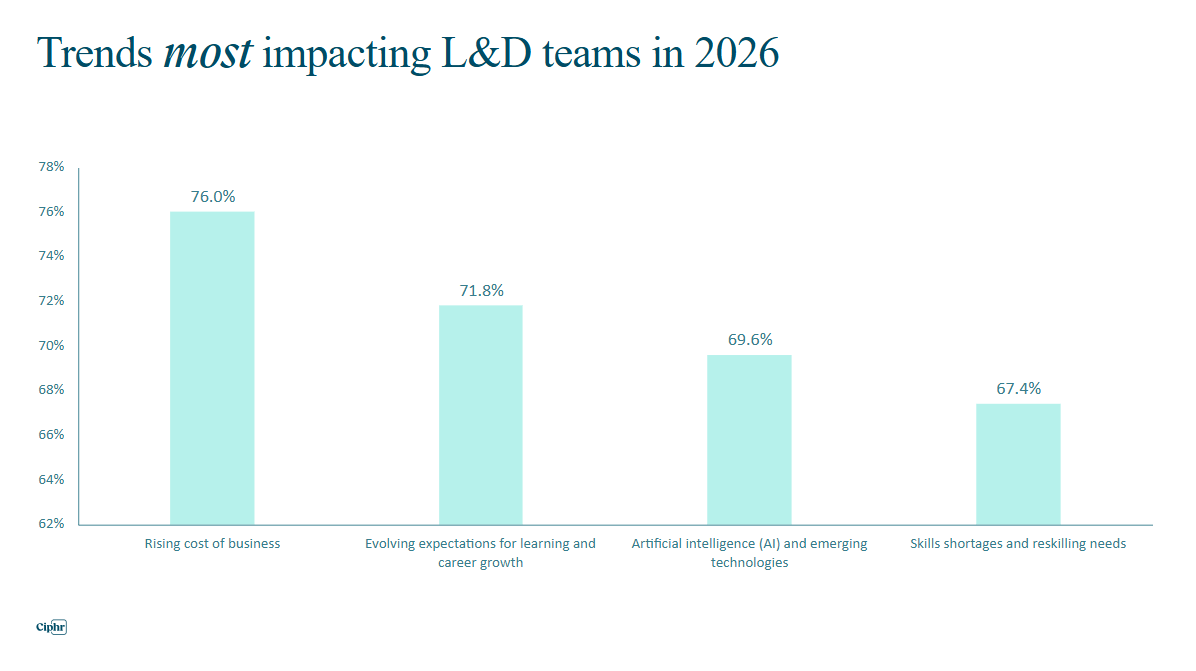
Together, these trends paint a picture of an environment where L&D teams are being asked to do more with less, while still delivering personalised, future-focused learning experiences.
How will organisations invest in L&D in 2026?
When it comes to budgets, the picture is mixed – but cautious optimism remains:
- They’ll keep spending the same – 37% of respondents
- They’ll invest more, but will be more strategic with spending – 35%
- They’ll cut costs – 21%
- They’ll invest more in L&D – 6%
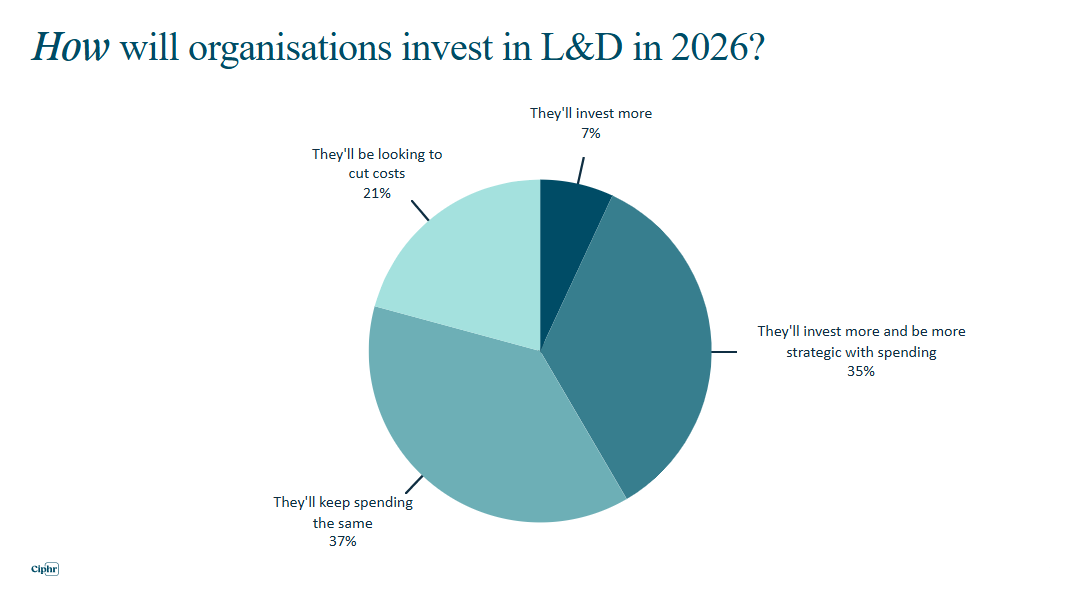
This suggests that while widespread budget increases may be unlikely, many organisations still recognise the importance of targeted, value-driven L&D investment.
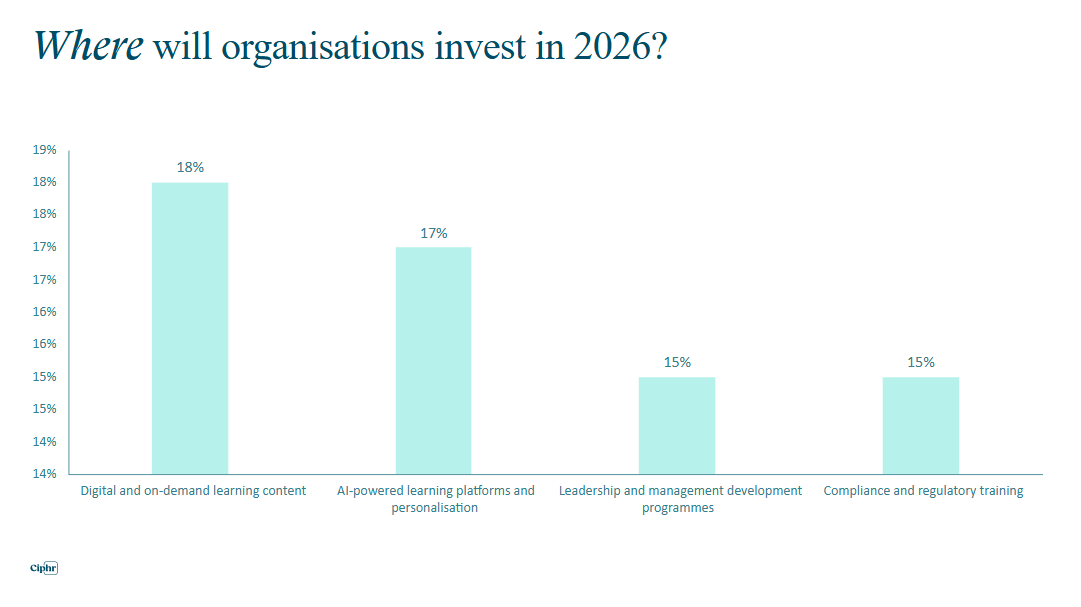
Which areas of L&D functionality will organisations invest more in in 2026?
Respondents told us they are prioritising investment in areas that offer flexibility, scalability and measurable impact:
- Digital and on-demand learning content – 18% of respondents
- AI-powered learning platforms and personalisation – 17%
- Leadership and management development programmes – 15%
- Compliance and regulatory training – 15%
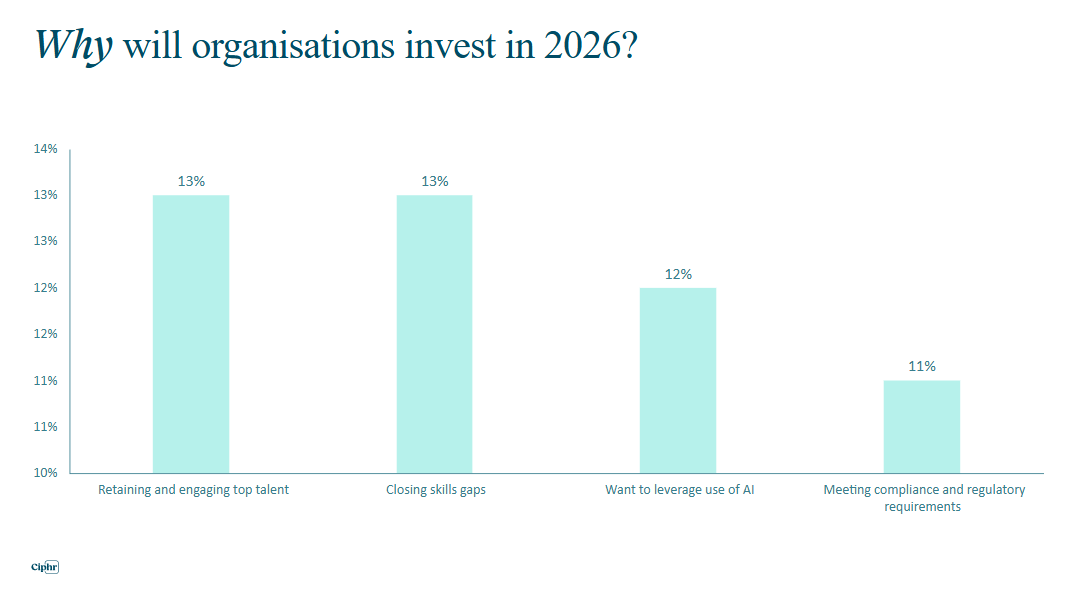
What will be the major drivers behind L&D investment in 2026?
The motivations behind these investments are firmly people-focused:
- Retaining and engaging top talent – 13% of respondents
- Closing skills gaps – 13%
- Desire to leverage use of AI – 12%
- Meeting compliance and regulatory requirements – 11%
L&D trends 2026: challenges L&D teams will face
Our survey highlights several challenges that L&D teams expect to grapple with in 2026:
- Offering competitive salaries/benefits packages – 88.4% find this somewhat or significantly challenging
- Skills shortages – 85.5%
- Creating an inclusive culture – 53.6%
- Using AI safely, effectively and ethically – 49.3%
Let’s explore these challenges – and potential solutions – in more detail.
Challenge 1: offering competitive salaries/benefits packages
As financial pressures continue, L&D teams are feeling the strain of balancing reward expectations with limited budgets.
Specific challenges include:
- Tight budget constraints alongside rising salary expectations
- Increased competition for digital and AI-savvy L&D professionals
- Perceptions of L&D as a cost centre, making ROI harder to demonstrate
- Benefits offerings that don’t always align with modern expectations around flexibility, wellbeing and career growth
Possible solutions include:
- Benchmarking salaries and being transparent about your reward philosophy
- Taking a total reward approach that values flexibility, development budgets and wellbeing
- Positioning career development and progression as key benefits
- Building data-driven business cases that clearly link L&D to retention and performance
- Exploring creative compensation models, such as performance bonuses or flexible benefits
Challenge 2: trying to compensate for and plug skills shortages
Skills shortages continue to place pressure on already stretched L&D teams, limiting their ability to focus on strategic priorities.
Specific challenges include:
- Reduced capacity for large-scale initiatives like digital learning and leadership programmes
- Slower digital transformation due to gaps in eLearning, LMS administration and AI expertise
- Overburdened teams, increasing the risk of burnout
- Difficulty meeting compliance, technical and soft-skills training needs
- Retention risks as skilled L&D professionals remain in high demand
Possible solutions include:
- Investing in upskilling through certifications and emerging technology training
- Using technology to automate admin tasks and free up capacity
- Developing internal talent pipelines through rotations, apprenticeships and graduate schemes
- Partnering with external specialists for targeted expertise
- Strengthening employer branding to attract and retain L&D talent
- Using skills gap data to plan for future needs
Challenge 3: creating an inclusive culture
Building inclusive learning experiences remains a priority, but this challenge remain. Including:
- Bias in learning content and a lack of representation
- Limited awareness or buy-in from leaders and employees
- One-size-fits-all learning that doesn’t reflect diverse needs
- Accessibility barriers within platforms and content
- Difficulty measuring the impact of inclusion initiatives
- Complexity across global or culturally diverse workforces
- Resistance to DEI initiatives perceived as compliance-driven
Possible solutions include:
- Auditing and refreshing content to remove bias and increase representation
- Embedding inclusion into leadership, onboarding and core learning programmes
- Personalising learning through adaptive technology and varied formats
- Ensuring eLearning courses meet accessibility standards, such as captions and WCAG compliance
- Equipping leaders with inclusive leadership skills
- Measuring impact through feedback and storytelling
- Leveraging employee resource groups and building cultural intelligence
Challenge 4: using AI safely, effectively and ethically
AI offers exciting potential – but it also introduces new responsibilities for L&D teams.
Specific challenges include:
- Data privacy and GDPR compliance concerns
- Algorithmic bias and lack of transparency
- Knowledge gaps and misconceptions about AI
- Ethical considerations around job security and the loss of human connection
- Quality control of AI-generated content
- Resistance or distrust from employees and leaders
- Cost, integration and governance requirements
Possible solutions include:
- Establishing clear AI governance and ethical guidelines
- Upskilling L&D teams in AI literacy and critical evaluation
- Taking a human-in-the-loop approach where AI supports, not replaces, expertise
- Conducting regular bias audits
- Designing privacy-first systems
- Being transparent with learners about how AI is used
- Piloting AI tools before scaling
- Keeping learning human-centred, with AI supporting efficiency rather than replacing connection
L&D trends 2026: eLearning trends and priorities
2026 eLearning trends
Looking ahead, we expect several eLearning trends to shape the L&D landscape in 2026:
- Using generative AI to create content, with continued human oversight for quality and accuracy
- Mobile-first design, enabling learning anytime, anywhere
- Enhancing accessibility, through screen reader compatibility and inclusive design choices
- Scenario-based learning, helping learners apply knowledge in real-world contexts
- Social learning features, encouraging collaboration and shared learning
2026 eLearning priorities
In 2026, L&D teams are likely to focus on:
- Using AI to personalise learning and drive analytics
- Embedding continuous learning through microlearning
- Gamification and immersive technologies
- Compliance assurance
- Maximising accessibility
- Ensuring practical, real-world application of skills
Want the full scoop on L&D trends 2026? Watch the webinar hosted by our L&D and eLearning specialists Zoe Bloomfield and Meg Halpin-Webster:
Overall, L&D trends 2026 point to a clear shift towards more strategic, data-driven and human-centred learning. Technology will play a crucial role in enabling scale and efficiency, but people – their growth, wellbeing and experience – will remain firmly at the heart of development.
If you’d like to explore how to turn these trends into action, download our brochure to learn more about our learning solutions, or book a demo to see how we can support your organisation’s L&D goals in 2026 and beyond.